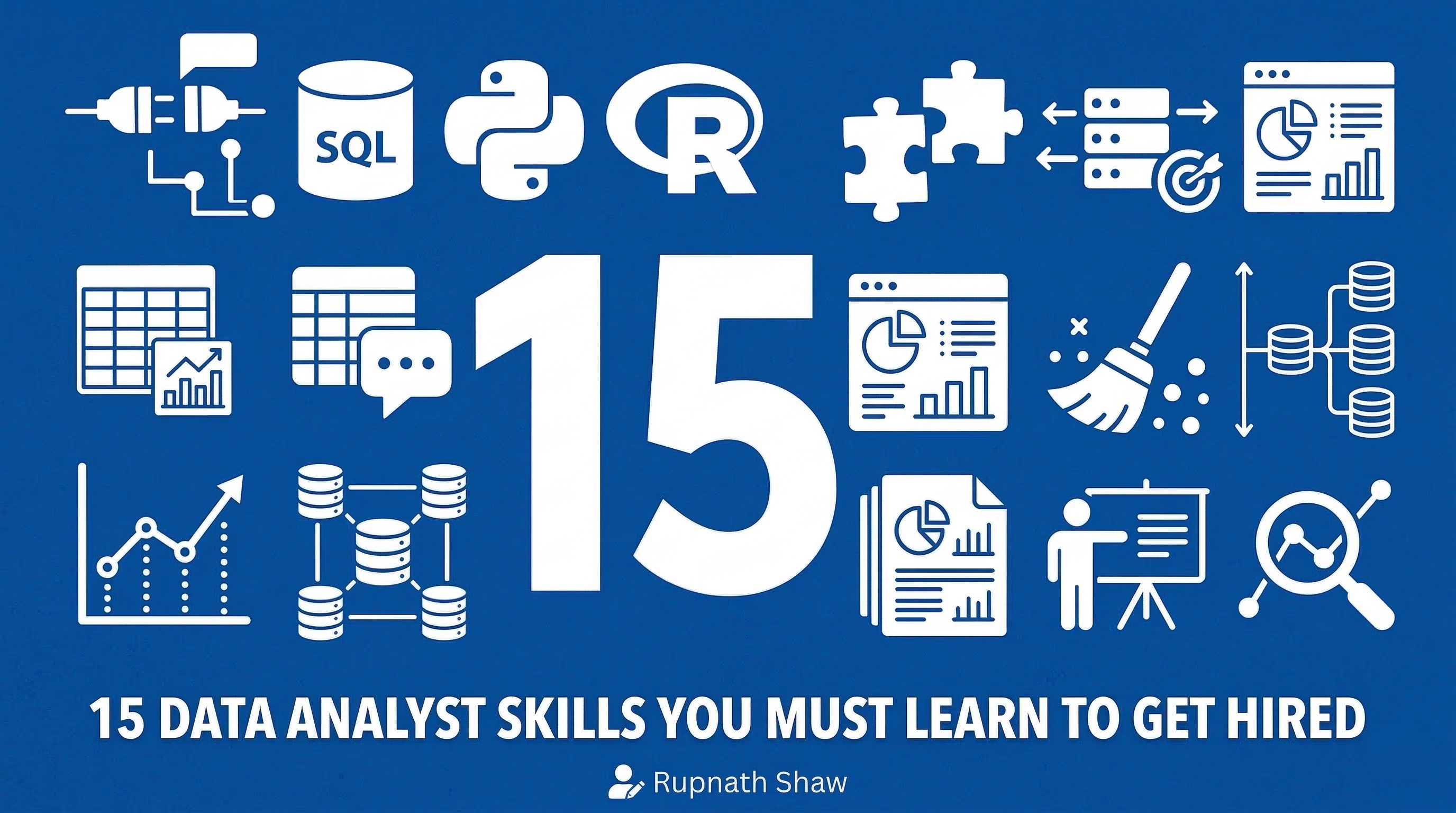
The job market is more competitive than it was two years ago. These are the skills that separate the candidates who get interviews from those who do not.
Data analyst job postings have changed a lot in the last two years. They used to ask for Excel and basic SQL. They now want skills in Python, cloud platforms, and storytelling. Sometimes, they also ask for a basic understanding of machine learning pipelines. The bar moved. A lot of candidates have not.
The good news is that the skill gap is closable. You don’t need a degree to learn any of these 15 skills. Most can be mastered in less than three months with regular practice. Are you learning what truly matters or just what’s on every basic list?
These 15 skills come from actual job postings for data analyst roles in 2025 and 2026. They span IT services, product companies, analytics firms, and startups.
They are divided into three groups:
-
Technical foundations
-
Tools and platforms
-
Softer skills, which many candidates overlook until it’s too late.
Category 1: Technical Foundations
These are the non-negotiables. Every data analyst job at every level requires these. If your foundation here is weak, the tools on top of it do not matter.
-
SQL
SQL is the most asked-for skill in data analyst job descriptions globally and in India. You do not need to know advanced database administration.
Create clear queries to:
-
Join tables
-
Aggregate data
-
Filter results
-
Use window functions like RANK(), ROW_NUMBER(), and LAG()
Practice on real datasets using LeetCode SQL, Mode Analytics, or StrataScratch.
-
Python for Data Analysis
Python has replaced Excel as the tool of choice for serious data work.
Focus on three libraries:
-
Pandas for data manipulation.
-
NumPy for numerical operations.
-
Matplotlib or Seaborn for visualization.
You do not need to learn machine learning to call yourself a data analyst. You need to be fast and confident with data wrangling.
-
Statistics and Probability
You cannot explain what your analysis means without statistics.
Focus on these key areas:
-
Descriptive Statistics: Understand mean, median, and standard deviation.
-
Hypothesis Testing: Learn about t-tests and chi-square tests.
-
Correlation vs. Causation: Know the difference.
-
Probability Distributions: Explore various types.
These come up in interviews constantly and most candidates cannot explain them clearly.
-
Data Cleaning and Wrangling
Roughly 70 to 80 percent of real data work is cleaning. Missing values, inconsistent formats, duplicate records, outliers. Employers want to know that you will not hand them a dashboard built on dirty data. Practice cleaning messy, real-world datasets — not the clean practice datasets from beginner tutorials.
-
Excel (Still Relevant, Just Not Alone)
Excel is not dead. It is just not enough on its own anymore.
You should know these key skills:
-
VLOOKUP
-
INDEX MATCH
-
Pivot tables
-
Conditional formatting
-
Basic data validation
It comes up in client-facing roles and at companies that have not fully migrated to BI tools yet.
Category 2: Tools and Platforms
These are the tools that appear most frequently in analyst job descriptions right now. Knowing at least two or three of these at a working level is expected at entry-level. Deep expertise in one separates you further.
-
Power BI or Tableau
Pick one and go deep. Power BI is dominant in corporate environments in India and the Microsoft ecosystem. Tableau is more common in product companies, US-headquartered firms, and analytics-focused roles. Learn DAX if you go with Power BI. Learn calculated fields and Level of Detail expressions if you go with Tableau. Build two to three real dashboards and put them on your portfolio.
-
Google Analytics / GA4
Any analyst role linked to a product, website, or marketing will ask about Google Analytics. GA4 replaced Universal Analytics in 2023 and many companies are still mid-migration. You can stand out from applicants still learning the new interface. Just know sessions, events, conversion funnels, and audience segmentation well.
-
Cloud Platforms — At Least One
AWS, Google Cloud, and Azure all have data services that companies use to store and process data. You do not need a cloud architect certification. You need to know what BigQuery is. You should be able to run a SQL query in the cloud. Also, understand what S3 or Blob Storage means. Google Cloud’s free tier and BigQuery sandbox are good starting points.
-
Jupyter Notebooks and Git
Jupyter Notebooks are the standard environment for Python-based data analysis. Git and GitHub are how analysts version-control their work and share it. Both are expected in technical interviews. A GitHub profile with three to four data projects is a credible portfolio. An empty one is a missed opportunity.
-
Basic Knowledge of Machine Learning Concepts
You do not need to build models as a data analyst. You need to know what a regression model does. Understand what classification means, too. Also, learn how to interpret model outputs. This often appears in interviews at product companies. It’s common for analytics teams that work with data scientists. You can find valuable info in Scikit-learn’s documentation. Also, a beginner ML course on Coursera can teach you a lot.
Category 3: Business and Communication Skills
These are the skills that turn a technically competent analyst into someone a company actually wants to hire. They are harder to learn from a course and easier to develop through practice and feedback.
-
Data Storytelling
Producing correct analysis is only half the job. Present it clearly. This way, a non-technical stakeholder can understand, trust, and act on it. Work on structuring your findings into a clear narrative. Practice explaining your projects to someone who does not know data. If they do not understand what you are saying, the presentation is the problem, not the audience.
-
Business Domain Understanding
Recruiters notice when a candidate can connect their analysis to a business outcome. A sales analyst who knows sales cycles and churn is more valuable than one who just knows pivot tables. Select a domain: e-commerce, finance, healthcare, or marketing. Next, discover the important KPIs in that field.
-
Critical Thinking and Problem Framing
Most real data problems are vague. ‘Revenue is down. Find out why.’ This is where critical thinking matters. Break ambiguous problems into clear questions. Decide what data to examine. Know when your analysis is on track and when more data is needed. This skill is almost impossible to fake in an interview.
-
Attention to Detail and Data Validation
Errors in analysis cost companies money and credibility. Employers want analysts who double-check their work. This means verifying totals, reviewing outputs, and spotting errors before others do. Mentioning this in an interview with a specific example is more convincing than listing it as a bullet on your resume.
-
Communication and Stakeholder Management
Data analysts do not work in isolation. They take requirements from stakeholders, push back when the request does not make sense, and present results to people who did not ask for them. Clear and concise writing, such as emails and reports, is just as vital as speaking in many corporate jobs. Both are learnable with practice.
Wrapping Up
Fifteen skills is a long list. You do not need all of them before you apply for your first role. Here is the minimum viable set that will get most entry-level analyst applications past the first filter:
-
SQL — clean, confident query writing
-
Python — pandas and matplotlib at a working level
-
Power BI or Tableau — at least one, with real dashboards to show
-
Basic statistics — enough to explain your analysis clearly
-
Data storytelling — the ability to explain what you found and why it matters
Add the rest as you go. The skills that matter most are not the ones on your resume. They are the ones you can demonstrate when someone puts a messy dataset in front of you and asks what you see.
Read Also:
Best Power BI Certifications and Training for Beginners in 2026
Step-by-Step Guide to Crack the Cognizant Analyst Trainee Interview in 2026
Job Notification Join us on Telegram: Click here
Job Notification Join us on WhatsApp: Click here