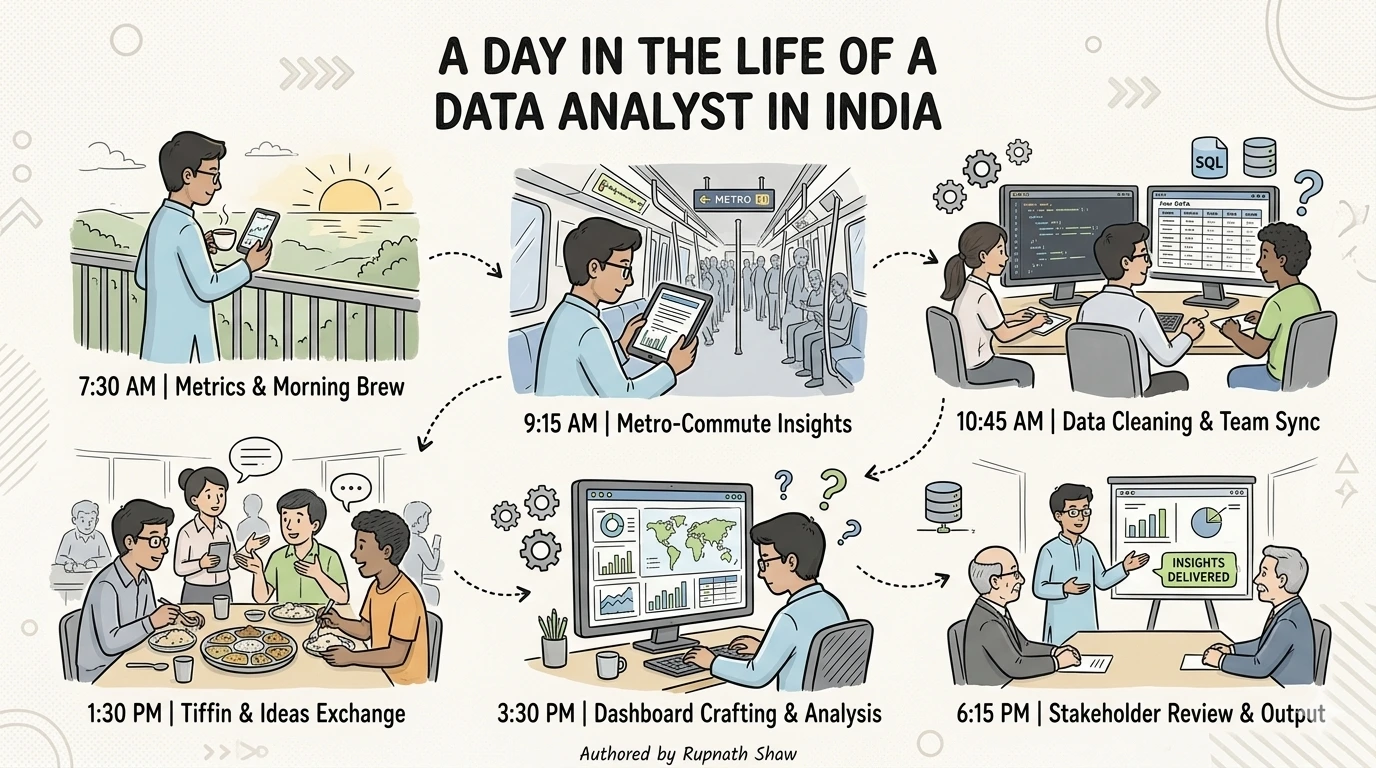
Not the LinkedIn version. The actual one.
When people ask me what a data analyst does, I usually say something polished and vague. Something about turning data into decisions. Stakeholder communication. Driving business insights.
None of that is wrong. It is also not what the day actually looks like.
The day is filled with SQL that often fails on the first try. There’s a meeting that could have been an email. A dashboard refresh is scheduled at the wrong time. Plus, you get a Slack message asking if a number is correct while you’re still figuring out why it isn’t.
A normal day for a data analyst at a mid-sized company in India looks like this. It’s different from a startup where you might be the only analyst or a large MNC with a team of fifteen. Somewhere in between. A company that takes data seriously but does not have unlimited resources. Most analyst jobs in India look something like this.
9:00 AM — The First Thirty Minutes Are Never What You Plan
The day starts with Slack. Always Slack. Or Teams, depending on where you work. Before standup, there are often two or three messages. One is from a business stakeholder. They ask why a number in yesterday’s report doesn’t match another report. The second message is from a teammate. They want you to review a query they wrote. Lastly, there’s an automated alert. It’s about a pipeline that ran overnight and hit a validation threshold.
The pipeline alert is noise. It has triggered before on data that was fine. The mismatched number is more interesting. You open the two reports and spend ten minutes tracing where they pull from. Different date filters. One is calendar month, one is rolling 30 days. The stakeholder just needed that explained, which you do in two sentences and a screenshot.
That is the first thirty minutes. Nothing from the to-do list got touched. This is normal.
9:30 AM — Standup — Ten Minutes, Sometimes Twenty
Most analytics teams run a short daily standup. You share what you are working on today, flag anything that is blocked, and hear what everyone else has going on. In practice this is useful for maybe half the people in the meeting at any given time and mildly irrelevant for the other half. You learn to give a concise update and pay attention only to the parts that affect your work.
Today someone mentions a data source change coming at the end of the week. It affects one of your dashboards. You make a note and add it to your task list. That note will prevent a two-hour debugging session on Friday. This is what standup is actually for catching things before they become problems.
9:45 AM — The Actual Work Starts: Data Pulling and Cleaning
The main task for today is a sales performance analysis the business team requested on Monday. They want to know which product categories did poorly last quarter. They also want to see how much they underperformed compared to the same quarter last year.
You write the SQL query. It pulls data from three tables: transactions, products, and a date dimension. It doesn’t run smoothly the first time. This happens because one product category column has inconsistent casing. Some entries say ‘Electronics’, some say ‘electronics’, some have a trailing space. Use TRIM and LOWER in the query to fix it. Also, note to flag this for the data engineering team. It will cause the same issue in every analysis using this column.
This kind of thing finding a data quality issue while doing something else — is a significant part of the job. You are not just an analyst. You are also, whether the job description says so or not, a data quality monitor.
You are not just pulling numbers. You are the person who notices when the numbers do not make sense — and then figures out whether the problem is in the data or in the business.
11:00 AM — Stakeholder Meeting — Translating Between Data and Business
There is a one-hour meeting with the sales team to align on the analysis before you build the final output. These meetings are where the real work of being an analyst happens, and most people outside the role do not realise it.
The sales lead wants one number: which category had the biggest drop. You have the number. You found that the category with the biggest absolute drop had the smallest percentage drop. Also, the category with the largest percentage drop is so small that its impact on the business is negligible. This distinction matters for the decision they are about to make.
You explain this. There is a moment where the framing of the entire question shifts. That moment is why the role exists. Anyone can pull the number. Knowing which number actually answers the question, and explaining why, is the skill that does not show up on a resume checklist.
The meeting ends with a clearer brief than you started with. The deliverable is now a two-slide summary, not the full dashboard the original request implied. This is also normal. Scope changes in both directions.
12:30 PM — Lunch and the Midday Slowdown
Lunch is lunch. In a Bangalore or Mumbai office this might mean going out. In a Hyderabad or Pune setup it might be the canteen or food delivery to your desk. WFH means reheating something while your laptop screen dims from inactivity.
The hour after lunch is the hardest hour to do deep work. Most experienced analysts schedule their meetings here and protect the morning for analysis. It takes a few months to figure this out but once you do, you stop scheduling anything that requires your full attention between 1 PM and 2:30 PM.
2:00 PM — Building the Output — Where Most of the Time Actually Goes
The afternoon is for building. Today that means taking the cleaned SQL output, loading it into Power BI, and building the two-slide summary that came out of the morning’s meeting.
Slide one is a simple bar chart: category performance this quarter versus the same quarter last year. Slide two features a table with three columns: category, absolute change, and percentage change. It is sorted by business impact, not by the largest numbers. The formatting alone takes longer than expected. Fonts, colours, axis labels, making sure nothing gets cut off when exported to PDF.
People outside the role consistently underestimate how much time formatting takes. The analysis takes two hours. The presentation takes one. This ratio is uncomfortable but real.
4:00 PM — Ad Hoc Requests — The Ones That Show Up at 4 PM
Without fail, at least one ad hoc request arrives in the afternoon. Today it is the marketing team asking for a quick breakdown of email campaign open rates by customer segment. They need it before tomorrow’s campaign review. It is not complex but it is not on your plan for today.
This is part of the job and pretending it is not does not help. Ad hoc requests are how an analyst builds credibility with stakeholders. Handling requests quickly and accurately is key. If people feel valued, they’ll trust your work. This trust brings them back for bigger analyses later.
You pull the data, check it, format it into a clean table, and send it within forty minutes. The marketing team thanks you. This will not appear on your performance review. It matters anyway.
5:15 PM — EOD Wrap-Up and the Next Day’s Setup
The last thirty minutes of a good analyst day are for closing loops. Check if the sales analysis is ready to send. Add a one-paragraph summary of the findings above the charts since the audience often skips the charts. Then, send it to the stakeholder, highlighting the key finding in the email body.
You update your task list for tomorrow. Three things carried forward, two new things added, one thing you can mark done. You push the pipeline fix to a ticket for the data engineering team with enough context that they do not need to ask you follow-up questions.
Then you close the laptop. Or you do not, because something came in at 5:45. That happens too.
What Nobody Tells You About the Role
Before you decide whether this career is for you, a few things that do not show up in job descriptions:
-
Most of your day is not analysis. It is data preparation, communication, and coordination. The actual insight-generating part is maybe thirty percent of a typical week.
-
You will be wrong sometimes and you have to own it clearly. A number you reported last week gets questioned this week and turns out to have an error in the filter logic. How you handle that moment defines your reputation more than any correct analysis you have ever delivered.
-
The most valuable skill is asking the right question before you start building. Two hours of analysis in the wrong direction is two hours gone. Spending fifteen minutes clarifying the actual question at the start saves that time every single time.
-
Stakeholder relationships determine a large part of your output quality. If people trust you, they give you better context. Better context produces better analysis. Being reliable and communicating clearly starts a virtuous cycle. It doesn’t begin with technical brilliance.
-
The tools are secondary. The thinking is primary. SQL, Power BI, and Python are instruments. Knowing what question to ask, how to structure the answer, and how to present it clearly is the actual job.
Wrapping Up
A data analyst’s day in India isn’t like a data science movie. It’s more about investigation, communication, and careful data work. The highs are real the meeting where a chart you built changes the direction of a business decision is genuinely satisfying. So is the moment a messy dataset finally makes sense.
The rest of it the Slack messages, the formatting, the 4 PM ad hoc requests is just the work. And like most work, it is fine once you stop expecting it to be something it is not.
If you want a career where you find patterns in data, explain them, and influence decisions with evidence, this is the one for you. The job description is not wrong. The timeline is just less cinematic than the brochure suggests.
Read Also:
Best Power BI Certifications and Training for Beginners in 2026
10 Beginner Data Analyst Projects to Add to Your Portfolio
Excel vs Power BI vs Tableau for Data Analysts (2026 Guide)
Job Notification Join us on Telegram: Click here
Job Notification Join us on WhatsApp: Click here