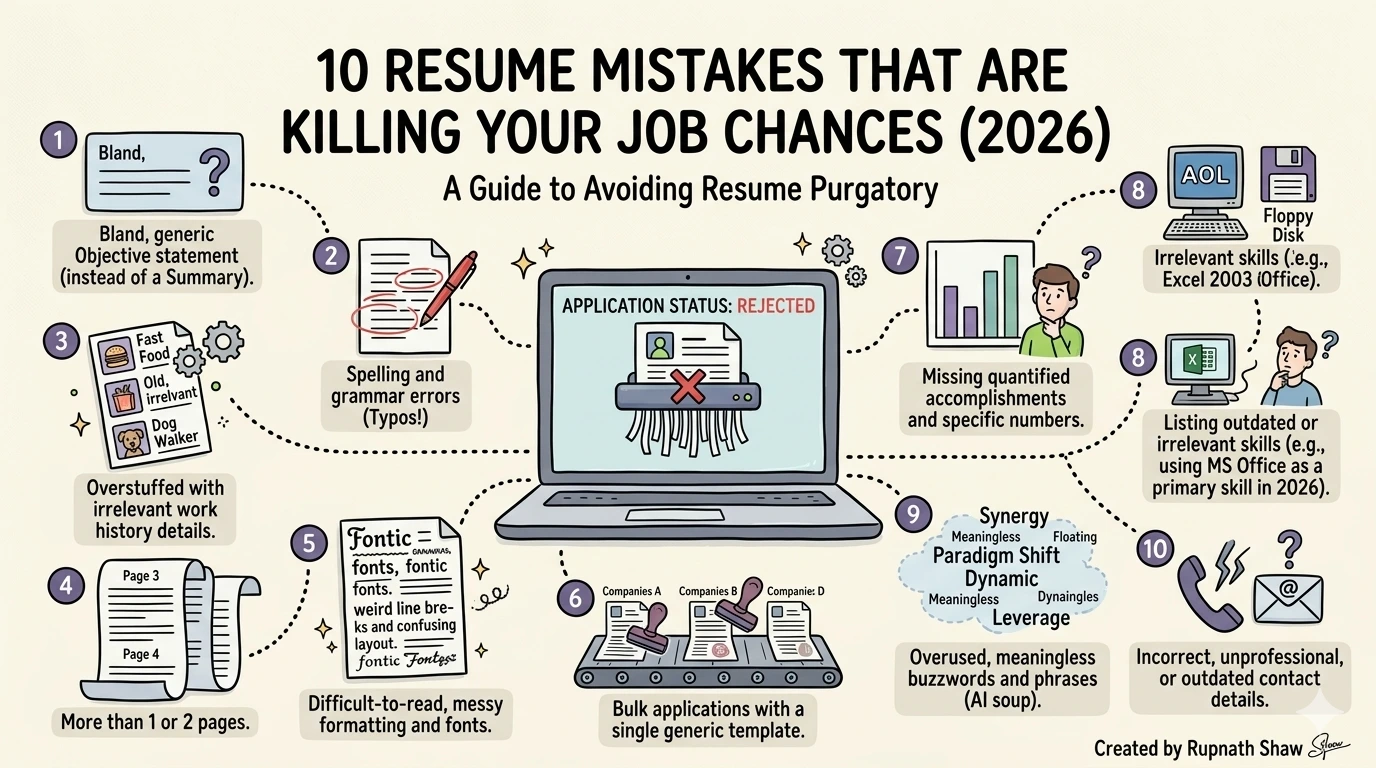
Most rejections are not about your qualifications. They are about what your resume communicates in the first ten seconds.
You sent forty applications. You heard back from two. You updated your resume, made it longer, added more skills, changed the template. Still nothing.
The issue is rarely about your qualifications. It’s usually about your resume making it easy for recruiters to overlook you. Recruiters sift through many resumes, often a hundred at a time. They spend less than ten seconds on each one. Then, they decide if they want to read more. In those ten seconds, they look for reasons to pass, not reasons to call you.
These ten mistakes can lead to strong candidates being filtered out before interviews. Most are fixable in under an hour. Check your resume against the list of mistakes before your next application.
- A Generic Objective Statement That Says Nothing
The objective statement is the first thing a recruiter sees after your name. I want a challenging role in a dynamic organization. I can use my skills and help the company grow.” This is like a firm handshake and direct eye contact. It doesn’t say anything specific about you.
| What candidates write | What to write instead |
| Seeking a challenging and rewarding position in a reputed organisation where I can utilise my technical skills and grow professionally. | Computer Science graduate with hands-on SQL, Python, and Power BI experience across three data projects. Looking for a data analyst or BI role where I can work on business problems with real data. |
Why it hurts you: Generic objectives tell the recruiter nothing about your skills, your target role, or why you are interesting. Specific summaries tell them all three in two sentences.
- Responsibilities Listed Instead of Achievements
Many recent grads and early-career pros showcase their roles in projects or internships on their resumes. They often miss what the person actually did or what came from it. Responsibilities outline the job. Achievements highlight the person behind it.
| What candidates write | What to write instead |
| Responsible for data analysis and report generation. Assisted in creating dashboards for the sales team. | Analysed 80,000+ transaction records using Python and SQL to identify 3 underperforming product categories, presented findings that led to a change in the Q3 restocking plan. |
Why it hurts you: A recruiter reading a list of responsibilities learns what role you were in. A recruiter reading achievements learns what kind of analyst you are. Only one of those gets you shortlisted.
- Skills Section That Lists Everything and Proves Nothing
A skills section listing MS Office, C++, Java, Python, HTML, CSS, Leadership, Teamwork, and Problem-Solving won’t wow recruiters. It reads as unfiltered and unthoughtful. Worse, listing skills you cannot speak to in an interview is a liability, not an asset.
| What candidates write | What to write instead |
| MS Office, C, C++, Java, Python, HTML, CSS, Communication, Leadership, Time Management, Teamwork | Technical: Python (pandas, matplotlib), SQL (MySQL, window functions), Power BI (DAX, data modelling) | Concepts: EDA, Data Cleaning, Statistics | Tools: Git, Jupyter Notebook |
Why it hurts you: Recruiters who test skills in interviews will notice immediately if you listed something you cannot use. One credible skill you can demonstrate is worth ten you cannot.
- Two-Page Resume With Nothing to Fill Two Pages
Freshers with two-page resumes almost always have a one-page resume padded to two. Extra line spacing between sections, three-line descriptions that could be one, a skills section stretched across the full page. A recruiter recognises padding instantly. It signals that the candidate does not know how to prioritise.
| What candidates write | What to write instead |
| Two-page resume with repeated content, inflated descriptions, and extra whitespace used as filler | One tight, dense page where every line earns its place. If something cannot be defended as necessary, cut it. |
Why it hurts you: A one-page resume that uses every line well reads as confident and edited. A two-page resume that pads suggests the candidate could not decide what mattered.
- Using a Fancy Template With Columns and Icons
Colored columns and icons may appear broken in some Word versions. They can also look odd when scanned by company systems that sort resumes.
| What candidates write | What to write instead |
| Two-column template with a coloured sidebar, skill bars rated out of 5 stars, and social media icons | Single-column layout, white background, standard fonts like Calibri or Arial, clean section dividers. Saves as PDF and opens identically on every device. |
Why it hurts you: An ATS often cannot read text in tables or columns. Your well-formatted resume may arrive as garbled text. A recruiter scanning fast will not stop to figure out your layout.
- No Numbers Anywhere in the Entire Resume
Vague language without numbers forces a recruiter to take your word for everything. ‘Improved sales reporting’ means nothing without context. ‘Reduced monthly reporting time from 6 hours to 45 minutes by automating the data pipeline’ means a great deal. Numbers make claims verifiable and specific.
| What candidates write | What to write instead |
| Worked on data analysis projects and improved reporting efficiency for the team. | Automated a monthly Excel reporting process using Python, reducing preparation time from 6 hours to 45 minutes across a team of 4. |
Why it hurts you: Numbers are the only way to distinguish ‘I did this’ from ‘I did this well’. Without them, every candidate claim sounds identical.
- An Unprofessional Email Address
This one sounds minor. It is not. An email address like coolrohan99@gmail.com or prince.sharma007@yahoo.com signals a lack of professional awareness before the recruiter has read a single bullet point. Your email is on the first line of your resume. It is the first detailed thing a recruiter reads after your name.
| What candidates write | What to write instead |
| coolboy_rohan_123@yahoo.com or rocking.sharma@gmail.com | rohan.sharma@gmail.com or rohanrsharma@gmail.com — straightforward, clean, professional |
Why it hurts you: It takes three minutes to create a new Gmail address. An unprofessional one costs you credibility before the interview starts.
- Projects With No Context and No Link
A project section that lists project names without explaining what was done, what tools were used, what data was involved, or what the finding was is the most commonly wasted section on a fresher resume. It reads as a checkbox rather than as evidence of capability.
| What candidates write | What to write instead |
| Projects: Sales Analysis, COVID Dashboard, HR Analytics — Built using Python and Excel. | E-Commerce Sales Analysis | Python, pandas, Power BI | github.com/yourname/project\nCleaned 100K+ records, identified 3 underperforming categories, reduction in delivery delay correlated with 22% improvement in review score |
Why it hurts you: Projects are your work experience as a fresher. A vague project entry is a missed opportunity to prove you can do the job.
- Sending the Wrong File Format Without Checking
Word documents sent as .docx sometimes open differently depending on the recipient’s Office version — fonts shift, bullet points break, columns misalign. The resume you spent three hours formatting may look completely different on the recruiter’s screen. PDF preserves formatting exactly, on every device, every time.
| What candidates write | What to write instead |
| Sending resume.docx and hoping it opens correctly on the recruiter’s end | Export to PDF before every submission. Name the file clearly: Rohan_Sharma_Resume_2026.pdf — not Resume_final_v3_updated.pdf |
Why it hurts you: Formatting issues make a polished resume look amateur. PDF removes that risk entirely. It is a one-click fix that most candidates skip.
- Not Tailoring the Resume to the Job Description
Sending the same resume to every application is the most efficient way to get ignored. Job descriptions tell you exactly what the company is looking for. A resume that reflects those specific skills, those specific tools, and that specific framing of the role reads as relevant. A generic resume reads as a mass application.
| What candidates write | What to write instead |
| One standard resume submitted to every company across every role without any changes | Read the job description carefully. If it mentions SQL, your SQL experience should be prominent. If it mentions Power BI specifically, your Power BI projects should be visible in the first half of the resume. Adjust your objective statement to reflect the role title. |
Why it hurts you: Recruiters know when they are reading a tailored application versus a spray-and-pray submission. Tailored resumes get longer reads. Longer reads get interviews.
Wrapping Up
Ten mistakes, most of which are fixable in an afternoon. Here is the short version:
- Write a specific two-line objective or skip it — never write a generic one
- Replace responsibilities with achievements and add numbers wherever possible
- List only skills you can demonstrate — keep the section clean and categorised
- One page, single column, PDF, professional email address
- Write your projects with tools, numbers, outcomes, and a GitHub or portfolio link
- Tailor the top half of your resume to each job description before you apply
Fix these and your resume does one thing a generic resume cannot it makes a recruiter slow down. That is the only goal of a resume. Get the reader to stop skimming and start reading. Everything else follows from that.
Read Also:
Best Power BI Certifications and Training for Beginners in 2026
10 Beginner Data Analyst Projects to Add to Your Portfolio
Excel vs Power BI vs Tableau for Data Analysts (2026 Guide)
Job Notification Join us on Telegram: Click here
Job Notification Join us on WhatsApp: Click here