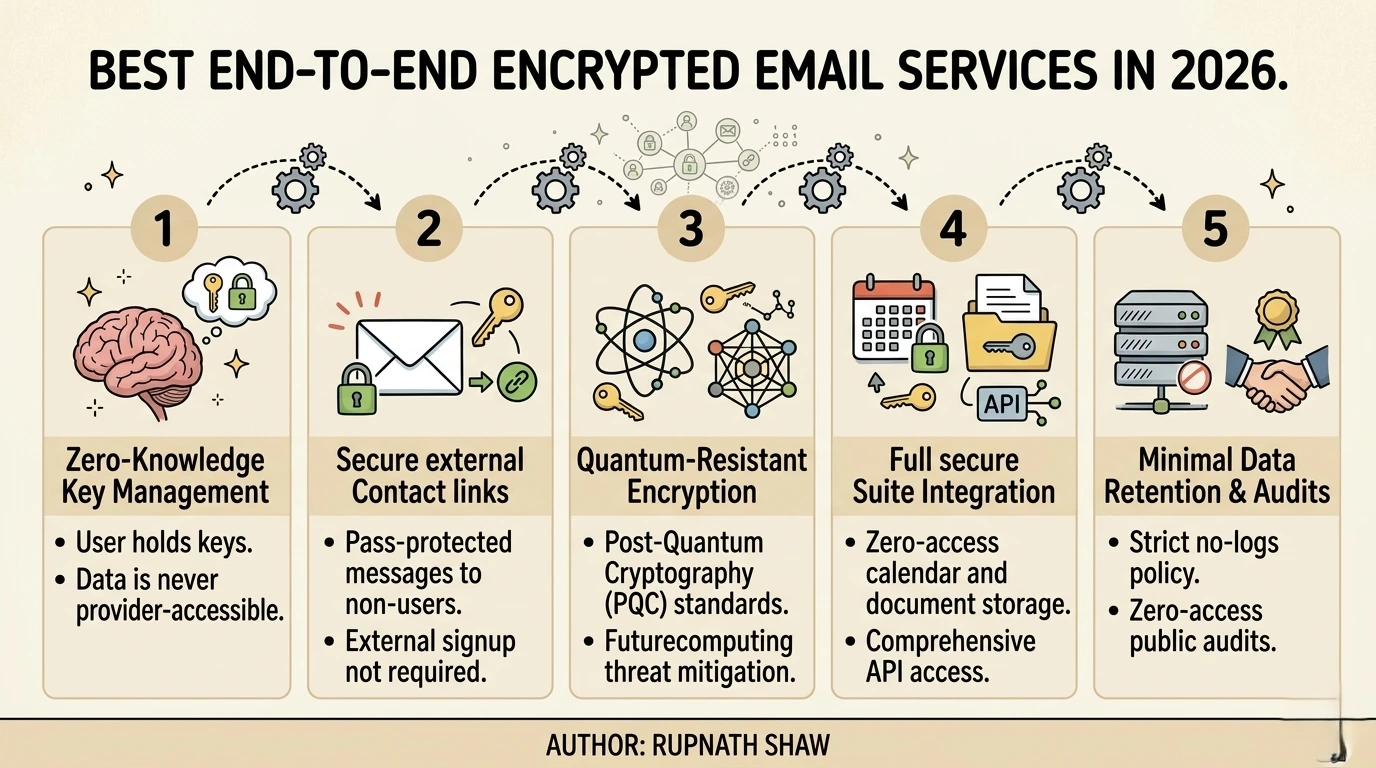
Gmail scans your inbox. Yahoo lets advertisers read your email. These services do not. Here is what genuine end-to-end encryption means and which providers actually deliver it.
When people say an email service is ‘secure’, they often mean one of several different things. Transport Layer Security (TLS) encrypts the connection between your device and the mail server but the provider can still read the email once it arrives. Zero-access encryption means the provider stores your email encrypted so they cannot read it at rest. End-to-end encryption (E2EE) means the email is encrypted on your device before it leaves, and only the recipient’s device can decrypt it nobody in between, including the provider, can read the content.
That third category genuine E2EE is what this guide covers. Services that claim to be secure but only offer TLS or server-side encryption are not included. The services below encrypt the content of your messages so that only you and your recipient hold the keys.
One important limitation to state upfront: subject lines and metadata (sender, recipient, timestamp) are difficult to encrypt fully in standard email protocols. Tuta Mail encrypts subject lines. Proton Mail does not. This distinction is noted for each service.
What End-to-End Encryption Actually Means for Email
True end-to-end encrypted email means the following guarantees hold:
- The provider cannot read your email content, even if compelled by a court order to hand over data they only have encrypted ciphertext
- If the provider’s servers are breached, attackers get encrypted data they cannot read without your private key
- The email is encrypted before it leaves your device and decrypted only after it arrives on the recipient’s device
- Your private key never leaves your device the provider never has access to it
Most mainstream email services Gmail, Outlook, Yahoo do not provide this. Gmail encrypts in transit and at rest, but Google holds the encryption keys, which means Google can read your email and has, in documented cases, shared access with third parties and advertisers. The services below are different at a technical architecture level.
The Best E2EE Email Services in 2026
- Proton Mail — proton.me
| Pricing | Jurisdiction | Encryption | Open Source | Best for |
| Free / from €3.99/month | Switzerland | E2EE (PGP), zero-access at rest | Yes | Everyone — best overall balance of security and usability |
Proton Mail is the most widely used end-to-end encrypted email service with over 100 million accounts and 50,000 business customers. It was founded by MIT and CERN researchers, is based in Switzerland under some of the world’s strictest privacy laws, and uses PGP-based E2EE with zero-access encryption for stored emails. Even Proton cannot read your messages. The service has passed multiple independent audits. The free plan provides 1GB of storage, E2EE, no ads, and access via web and mobile apps. Paid plans add storage, custom domains, aliases, and the Proton ecosystem including VPN, cloud storage, calendar, and password manager. One technical note: Proton Mail does not encrypt subject lines or metadata by default only the message body and attachments are E2EE. Emails sent to non-Proton addresses are protected using password-based encryption or PGP if the recipient supports it.
| Strengths: 100M+ users, established trust record, Switzerland jurisdiction, independent audits, full ecosystem (VPN, Drive, Calendar), easy to switch from Gmail via Easy Switch tool, Tracking Link Protection removes email trackers |
Limitations:
Subject lines are not encrypted — only body and attachments. PGP encryption is technically limited when emailing non-Proton users. Free plan storage (1GB) is modest |
► The best starting point for almost everyone — widest use, strongest ecosystem, cleanest usability
- Tuta Mail (formerly Tutanota) — tuta.com
| Pricing | Jurisdiction | Encryption | Open Source | Best for |
| Free / from €3/month | Germany (GDPR) | E2EE with post-quantum cryptography, subject lines encrypted | Yes | Privacy maximalists and those who want the strongest encryption available |
Tuta Mail takes a more aggressive approach to encryption than Proton Mail. It encrypts not just the email body but also subject lines and address book entries — metadata that Proton Mail leaves unencrypted. In 2026, Tuta became the first mainstream email service to deploy post-quantum cryptography, which protects against future decryption attacks using quantum computers. It is fully open source, based in Germany under strong GDPR protections, and independently audited. The trade-off compared to Proton is ecosystem — Tuta does not have a VPN, cloud storage, or as broad an ecosystem. It also uses a proprietary encryption protocol for calendar and contacts rather than PGP, which some advanced users consider a limitation. For privacy-first users who want the strongest available encryption and do not need the broader Proton ecosystem, Tuta is arguably the stronger choice.
| Strengths:
Subject lines and contacts encrypted — stronger metadata privacy than Proton. Post-quantum cryptography — industry-first for mainstream email. Fully open source and independently audited. Strong German GDPR protections |
Limitations:
No VPN or broader ecosystem like Proton. Proprietary encryption protocol rather than PGP — less interoperable with external PGP users. Smaller user base than Proton. Limited third-party client support |
► The strongest privacy-first choice — pick Tuta if encrypted subject lines and post-quantum cryptography matter to you
- Mailfence — mailfence.com
| Pricing | Jurisdiction | Encryption | Open Source | Best for |
| Free (500MB) / from €2.50/month | Belgium (GDPR) | OpenPGP E2EE, digital signatures | No (proprietary) | Users who want PGP control alongside productivity tools |
Mailfence is a Belgian privacy-focused email service that provides OpenPGP encryption with in-browser key management alongside a suite of productivity tools including calendar, contacts, groups, and cloud document storage. It is frequently recommended as the email service that most closely combines genuine E2EE with a Gmail-level feature set. Users can generate and manage their own PGP keys directly in the browser without needing external tools. The free plan provides 500MB and covers the core security features. Mailfence is particularly well-suited for users in regulated industries who need E2EE alongside productivity features and who want to manage their own encryption keys explicitly.
| Strengths: OpenPGP with in-browser key management — user controls keys. Built-in productivity suite (calendar, documents, cloud storage). Belgian GDPR jurisdiction. Good balance of security and usability. Affordable paid plans |
Limitations:
Not fully open source — some backend code is proprietary. Free storage (500MB) is limited. Smaller user base than Proton or Tuta. Less polished mobile apps compared to Proton |
► The best choice for users who want explicit PGP key control alongside a full productivity suite
- Posteo — posteo.de
| Pricing | Jurisdiction | Encryption | Open Source | Best for |
| €1/month — no free plan | Germany (GDPR) | Optional E2EE (PGP), AES-256 at rest | No | Privacy-conscious users who want a minimalist paid service with anonymous payment |
Posteo is a German privacy-focused email service with no free tier but one of the most affordable paid plans on this list at €1 per month. Its key differentiator is its approach to anonymity — it accepts anonymous payment methods including cash, allows account creation without a phone number or backup email, and maintains minimal logs. It supports PGP for E2EE but does not enforce it by default — you opt into E2EE rather than having it on automatically. Posteo is independently audited, powered by renewable energy, and has a strong reputation among privacy researchers. It is best for users who value anonymity of payment and account creation alongside optional E2EE, rather than users who need E2EE enforced by default.
| Strengths:
Anonymous payment accepted (including cash). No phone number required for account creation. €1/month is one of the lowest paid prices. Independent audits. Renewable energy powered. Strong German GDPR jurisdiction |
Limitations:
No free plan. E2EE is optional, not default — requires manual PGP setup. Fewer features than Proton or Mailfence. No mobile app — web interface only. Limited storage on base plan |
► The right choice for users who prioritise payment anonymity and account creation privacy above all else
- StartMail — startmail.com
| Pricing | Jurisdiction | Encryption | Open Source | Best for |
| $35.99/year (7-day free trial) | Netherlands | PGP E2EE, unlimited aliases | No | Users who need unlimited email aliases alongside PGP encryption |
StartMail is operated by Startpage, the privacy-focused search engine, and is based in the Netherlands under GDPR. Its standout feature for privacy-conscious users is unlimited email aliases — while Proton Mail limits aliases on lower tiers and Tuta limits them similarly, StartMail allows unlimited alias creation on all plans. This makes it particularly useful for users who want to maintain multiple email identities, protect their real email address when signing up for services, or compartmentalize different areas of their online activity. It supports PGP E2EE and provides 20GB of storage. The interface is clean and the user experience is polished. It is not open source, which is a limitation for technically demanding users.
| Strengths:
Unlimited aliases on all plans — the standout feature vs competitors. 20GB storage. Clean polished interface. Netherlands GDPR jurisdiction. PGP support. 7-day free trial before committing |
Limitations:
Not open source — no independent code audit available. No free plan after trial. Less name recognition than Proton or Tuta. No companion ecosystem (VPN, cloud storage, etc.) |
► The best choice if unlimited email aliases for identity compartmentalization are a priority
Side-by-Side: All 5 Compared
| Service | Price | Subject encrypted | Open source | Free plan | Standout feature |
| Proton Mail | Free / €3.99+/mo | ✘ Body only | ✔ Yes | ✔ Yes | Full ecosystem + 100M+ users |
| Tuta Mail | Free / €3+/mo | ✔ Yes | ✔ Yes | ✔ Yes | Post-quantum encryption |
| Mailfence | Free / €2.50+/mo | ✘ Body only | ✘ No | ✔ Yes | PGP key control + productivity |
| Posteo | €1/month | ✘ Body only | ✘ No | ✘ No | Anonymous payment accepted |
| StartMail | $35.99/year | ✘ Body only | ✘ No | Trial only | Unlimited aliases |
How to Choose the Right One
- For most people switching from Gmail or Outlook: Proton Mail — the widest use, clearest path to switch, and strongest ecosystem. Start on the free plan and upgrade if you need more storage or aliases
- For maximum encryption strength and subject line privacy: Tuta Mail — post-quantum cryptography, subject lines encrypted, fully open source. The technically strongest option available
- For PGP key control with a productivity suite: Mailfence — the best combination of manual PGP management alongside calendar, contacts, and document tools
- For anonymous payment and minimal data collection: Posteo — cash payments accepted, no phone number required, strong German jurisdiction, €1/month
- For unlimited email aliases: StartMail — no other service on this list matches it for alias volume at any price tier
Wrapping Up
End-to-end encryption is not a luxury for privacy enthusiasts. It is the only reliable defense against a provider reading your email, a server breach exposing your messages, or a surveillance request forcing disclosure of content that the provider genuinely cannot access.
Every service on this list provides genuine E2EE for email bodies. Tuta Mail goes furthest by also encrypting subject lines and deploying post-quantum cryptography. Proton Mail goes furthest on ecosystem and accessibility. The right service depends on what you value most but any of them is a significant improvement over the mainstream alternatives that scan your inbox and sell the data.
Read Also:
Best Laptop for Cybersecurity Students in 2026
Best 10 Job Portals for Freshers in 2026
10 Excel Tricks Every Data Analyst Wishes They Knew Sooner
Job Notification Join us on Telegram: Click here
Job Notification Join us on WhatsApp: Click here