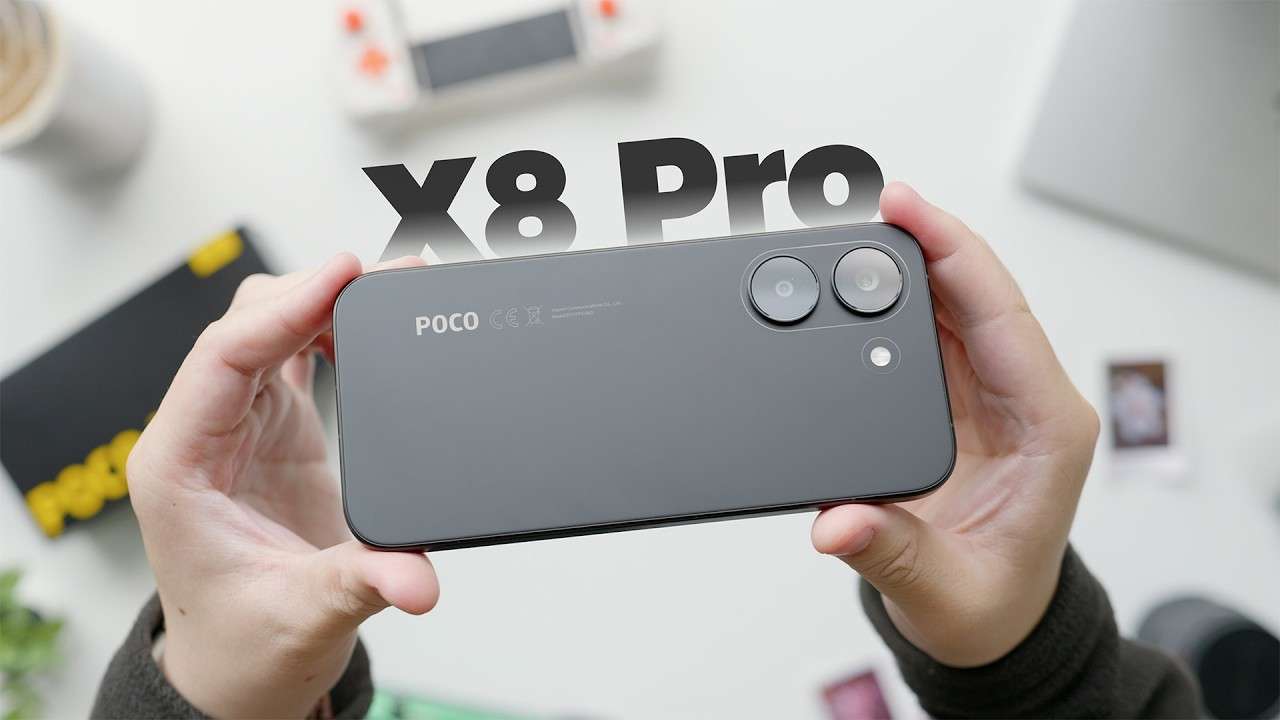
Price: ₹35,999 (Flipkart exclusive, charger bundled) Tested variant: 12 GB LPDDR5X / 256 GB UFS 4.1 / Black
The “Charger in the Box” tag on Flipkart’s listing deserves a moment of recognition, because in 2026 it’s mildly absurd that including a charger has become a selling point rather than the default. That mild absurdity aside, the POCO X8 Pro (12 GB / 256 GB, Black) is a genuinely good phone for ₹35,999 and the 100W HyperCharge adapter that ships in the box is one of the better ones you’ll get in this price bracket.
This review covers the specific Flipkart listing: the Black colour, 12 GB RAM, 256 GB storage, with the 100W charger bundled. The 8 GB / 256 GB base variant (₹32,999) does not always include the charger depending on your seller, so if fast charging is a priority, this listing is worth the extra ₹3,000.
What’s Actually in the Box
You get the phone, the 100W HyperCharge adapter, a USB-A to USB-C cable (6A rated you need this specific cable for full 100W speeds), a transparent silicone case, and a pre-applied screen protector. That’s a solid package. Most phones at this price ship without a case or protector. POCO bundling both means you’re protected before you leave the delivery box, which matters if you’re handing this to someone who doesn’t immediately buy accessories.
The charger itself is a Xiaomi-standard 100W GaN unit. It charges other devices fine too, though naturally at lower speeds than the phone.
Build and Design
The Black variant looks better in person than in product photos. It has a matte-finished polycarbonate back that doesn’t fingerprint badly and feels solid without adding unnecessary weight. The phone sits at 201.5 g and 8.4 mm thick this isn’t a thin phone, but it doesn’t feel bulky in the hand either.
The camera module is a pill-shaped protrusion on the upper left. Two lenses, an LED flash, and the POCO branding underneath. It’s a clean layout that doesn’t look cluttered.
POCO gave this phone IP66, IP68, and IP69K ratings triple water resistance certification that’s unusual below ₹40,000. IP68 covers submersion. IP69K adds resistance to high-pressure water jets. For the price, this level of durability protection is not something competitors match consistently.
Display
6.59-inch AMOLED, 1268 × 2756 pixels, 120 Hz adaptive refresh, 3,840 Hz PWM dimming, 3,500 nits peak brightness. The panel is good. The PWM dimming frequency is particularly worth noting high-frequency PWM reduces the flickering that causes eye strain at low brightness on OLED screens, and 3,840 Hz is among the better implementations you’ll find outside flagships.
The M10 panel runs Dolby Vision and HDR10+. Colors are accurate with the default profile, and the 3,500 nits brightness means the screen remains readable outdoors even on a bright day. The 1.7 mm bottom bezel and 1.5 mm side bezels make this one of the tighter bezelled phones at this price.
One thing to note: some early units shipped with a slight yellowish tint at low brightness, caused by HyperOS’s default colour temperature calibration. It’s adjustable in settings under Display → Colour and brightness. If your unit has this, spend two minutes calibrating it rather than returning the phone.
Performance — Dimensity 8500 Ultra
The MediaTek Dimensity 8500 Ultra is built on a 4nm process and sits in the upper tier of mid-range chips. In daily use app switching, social media, Chrome with multiple tabs, video calls it’s completely smooth. There’s no hesitation anywhere.
Gaming performance is the headline. BGMI, Genshin Impact, Call of Duty Mobile all run at high settings without thermal throttling during typical 30-45 minute sessions. The vapour chamber keeps things manageable. Extended gaming beyond an hour does warm the back, but it doesn’t get hot enough to trigger slowdowns.
The 12 GB LPDDR5X RAM helps. With the 8 GB variant, heavy multitasking can cause app reloads. The 12 GB configuration keeps more apps in memory, and if you’re someone who switches between multiple heavy apps (YouTube, Maps, WhatsApp, a game), the difference is noticeable.
UFS 4.1 storage is fast for this price. App installs are quick, and camera saves are instant.
Charging — The Actual Point of This Review
100W HyperCharge is genuinely fast. From empty to 77% in 30 minutes, and full charge in roughly 43-47 minutes on the 6,500 mAh battery. That’s a large battery filling up in under an hour, which is practically useful not just a spec to quote.
POCO uses silicon-carbon battery technology, which allows higher energy density without increasing size, and theoretically degrades more slowly than standard lithium-ion over hundreds of charge cycles.
The bundled cable matters here. The USB-A to USB-C cable in the box is rated for 6A, which is required for 100W speeds. If you use a standard USB-C cable you have lying around, you’ll likely cap out at 45W or lower. Keep the bundled cable, or buy a 6A-rated cable if you want a second one.
27W reverse wired charging is also supported. It’s slower than forward charging, but you can use the X8 Pro as a power bank for another device. Given the 6,500 mAh capacity, this is practically useful if a friend’s phone dies.
The charger in the box supports PD3.0, PD2.0, and PPS protocols, so it works with laptops and other devices up to its rated output. It’s a genuinely versatile adapter, not a single-device charger.
Battery Life
6,500 mAh with an efficient 4nm chip. Real-world endurance lands between 1.5 and 2 days on moderate usage calls, social media, some video, light gaming. Heavy use (gaming + streaming + 5G data) will get you through a full day comfortably, but not two.
For context: Expert Reviews’ looping video test put it at 26 hours 23 minutes, which is ahead of the Nothing Phone (4a) but behind some competitors with larger batteries like the OnePlus Nord 5. It’s a good result, not a record-breaking one.
Cameras — The Part That Disappoints
The 50 MP main sensor handles daylight photography fine for social sharing. Colours are accurate, detail is reasonable at full resolution, and the camera opens quickly.
The ultrawide is 8 MP. At this price, 8 MP ultrawide is underwhelming several competitors offer 50 MP or better ultrawide lenses. The output from the ultrawide is noticeably softer and lower quality than the main sensor.
There’s no telephoto. No optical zoom beyond the main lens.
Video maxes out at 4K 30fps from the rear and 1080p from the front. Nothing wrong with it, but nothing exceptional.
The honest summary: this is a gaming phone with competent cameras, not a camera phone with gaming capabilities. If you’re buying it for photography, it’s the wrong choice. If photography is secondary and you prioritise performance and battery, the cameras are fine enough.
Software — HyperOS 3 on Android 16
The phone ships with Android 16 and HyperOS 3. POCO has committed to 4 years of Android OS upgrades and 6 years of security patches — better than the commitment most mid-range manufacturers offer.
HyperOS 3 is cleaner than older MIUI versions, but it still ships with some pre-installed apps. There are ads in a few system apps by default. Both are disableable in settings, but you’ll spend 10-15 minutes clearing them out after setup.
The AI features AI writing assistant, AI search, AI photo editing tools work and are genuinely useful in daily use rather than just feature-list items.
The USB 2.0 Problem
At ₹35,999, the USB-C port runs on USB 2.0. This means data transfer speeds cap at 480 Mbps adequate for charging but slow for moving files. Transferring a 4K video from the phone to a laptop over cable takes noticeably longer than it would on a phone with USB 3.1. If you frequently transfer large files, plan to use wireless transfer or cloud backup instead.
This is a frustrating cost-cutting decision at this price point. It’s the main thing I’d change.
Should You Buy the 12 GB / 256 GB Charger-in-Box Listing?
Yes, if:
- You want the best gaming performance under ₹36,000 on this phone
- Fast charging matters and you don’t want to buy a charger separately
- IP69K water resistance is a priority — very few phones in this range have it
- You’re a heavy multitasker who benefits from 12 GB over 8 GB
No, if:
- Cameras are a primary purchase criterion — look at the OnePlus Nord 5 or Realme 16 Pro Plus instead
- You regularly transfer large files over USB — the 2.0 port will frustrate you
- 256 GB feels tight — the 12 GB / 512 GB variant exists, though it costs more
The 8 GB vs 12 GB call: For typical daily use, 8 GB is enough. If you game heavily and switch between multiple demanding apps frequently, the 12 GB variant holds more in memory and avoids reload stutters. The ₹3,000 difference between 8 GB and 12 GB is worth it if gaming and multitasking are daily habits.
Quick Specs Reference
| Spec | Detail |
|---|---|
| Display | 6.59-inch AMOLED, 1268×2756, 120Hz, 3,500 nits, 3,840Hz PWM |
| Processor | MediaTek Dimensity 8500 Ultra (4nm) |
| RAM | 12 GB LPDDR5X |
| Storage | 256 GB UFS 4.1 |
| Battery | 6,500 mAh (silicon-carbon) |
| Charging | 100W HyperCharge wired + 27W reverse wired |
| Rear cameras | 50 MP main + 8 MP ultrawide |
| Front camera | 20 MP |
| OS | Android 16 / HyperOS 3 |
| IP rating | IP66 + IP68 + IP69K |
| USB | USB-C (USB 2.0 — the one real disappointment) |
| Weight | 201.5 g |
| Price (this variant) | ₹35,999 on Flipkart |
Read Also:
Azure Synapse Analytics Tutorial for Data Analysts Complete 2026 Guide
50 SQL Interview Questions for Data Analysts With Answers
Job Notification Join us on Telegram: Click here
Job Notification Join us on WhatsApp: Click here