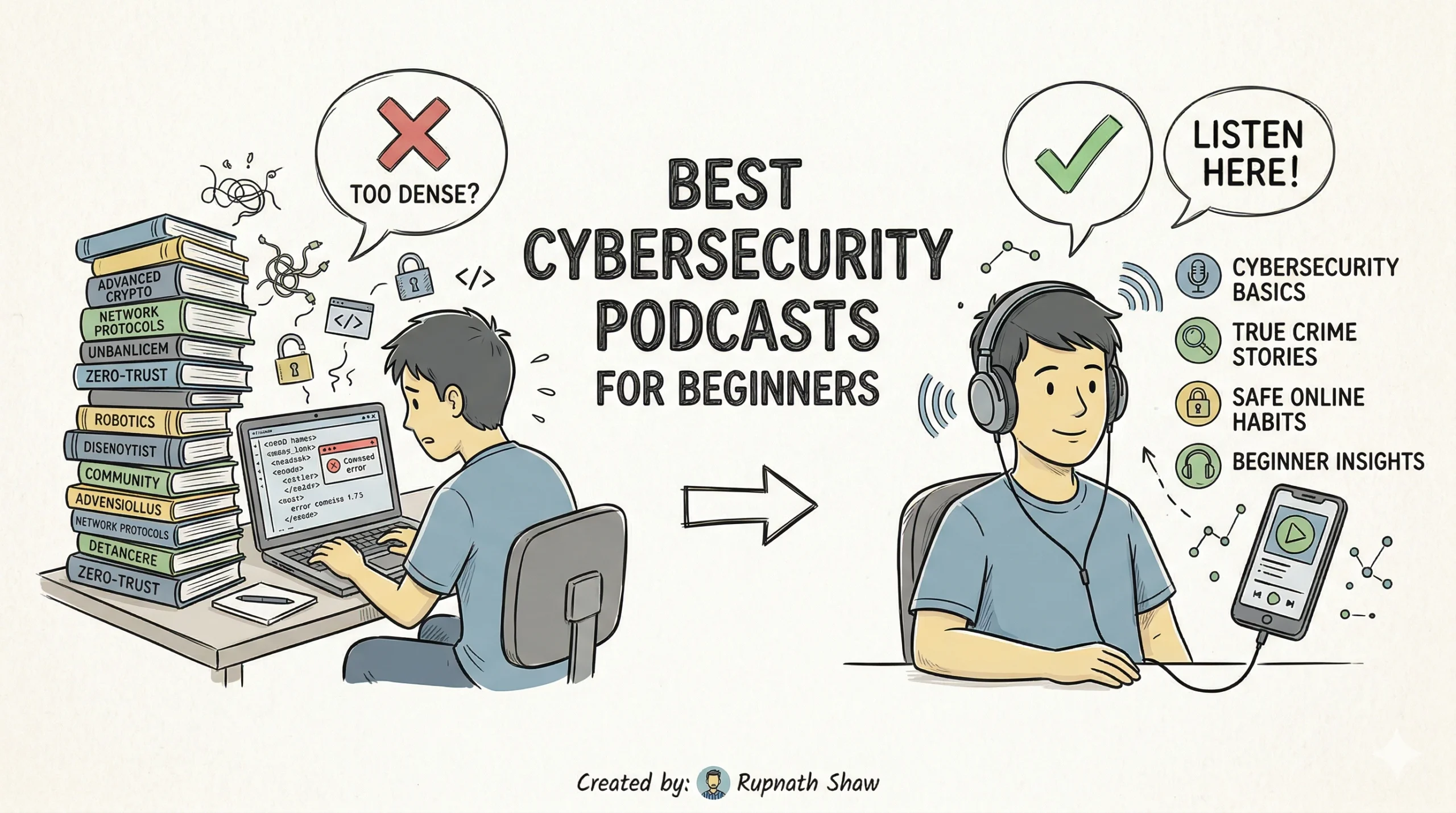
Not all cybersecurity podcasts are built for people who are just starting out. These 8 are ranked by how well they explain complex topics without assuming you already know the field.
The cybersecurity podcast space has a density problem. Most shows are made by experts for experts. They assume you know what a CVE is, what a SIEM does, and the difference between a red team and a purple team. If you’re new to the field, jumping into an average security podcast can feel like joining a chat halfway in a language you’re still mastering.
This list is different. These eight podcasts are great for beginners. Some are made for newcomers, while others use storytelling to explain technical ideas. This makes them easy to understand, no matter your background. Each one builds understanding without making you feel like you walked into the wrong room.
The list has two tiers:
-
Podcasts that are truly beginner-friendly in format and content.
-
Podcasts accessible to beginners due to how the topics are presented, even though professionals also listen.
Tier 1: Built for Beginners — No Prior Knowledge Required
These podcasts actively design for listeners who are new to cybersecurity. They define terms, explain threats, and make the field easy to understand. They don’t assume you already know everything.
- Darknet Diaries
| Host | Frequency | Episode length | Since | Style | Tech level |
| Jack Rhysider | Bi-weekly | 45–70 min | 2017 | True crime narrative | Beginner-friendly |
Best for: Complete beginners who want to understand cybersecurity through real, gripping stories
Darknet Diaries is a great way to learn about cybersecurity, even if you’re not technical. Jack Rhysider tells real stories of hacks and cybercrime in an exciting way. The show is very popular, with over a million downloads and top rankings. It helps beginners understand how attacks happen and what’s at risk in cybersecurity.
| What most beginners miss: The episode archive spans hundreds of episodes from 2017 onward. Begin with the most downloaded episodes shown on the website, not the newest ones. Older episodes on social engineering and insider threats are great starting points. They show that cybersecurity is a human issue, not just a technical one. |
Skip it if:
You already have a strong technical background and find narrative storytelling without technical depth unsatisfying. For those users, jump directly to Security Now or Risky Business |
- Smashing Security
| Host | Frequency | Episode length | Since | Style | Tech level |
| Graham Cluley and Carole Theriault | Weekly | 45–60 min | 2016 | Conversational, humorous news analysis | Beginner to intermediate |
Best for: Beginners who want to stay current on cybersecurity news with a light, approachable format
Smashing Security is a popular podcast that won awards in 2018, 2019, 2022, 2023, and 2024. Hosts Graham Cluley and Carole Theriault chat about cybercrime and tech news. They mix humor with insight, making it simple for beginners to follow.
| What most beginners miss:
The hosts openly share their disagreements. This honesty makes the analysis feel real. In other podcasts, everyone often just agrees. The ‘extra’ segments where Graham shares listener feedback often have the clearest explanations. They also follow up on previous episodes and clarify confusing topics. |
Skip it if: You want deep technical analysis of specific vulnerabilities or attack techniques. Smashing Security is news analysis with accessible commentary, not a technical education show |
- CyberWire Daily
| Host | Frequency | Episode length | Since | Style | Tech level |
| Dave Bittner | Daily (weekdays) | 20–30 min | 2015 | Daily news briefing | Beginner to intermediate |
Best for: Beginners who want a daily 20-minute briefing on what happened in cybersecurity today
CyberWire Daily helps you stay current on cybersecurity news. Host Dave Bittner delivers a 20-30 minute daily briefing on key security events. The show covers breaches, vulnerabilities, and threats. It also includes Career Notes and Research Saturday episodes. These offer helpful insights for beginners and detailed looks at specific topics.
| What most beginners miss:
Research Saturday episodes are usually more educational than weekday briefings. They help beginners build knowledge instead of just staying current. Subscribe to both if you have the listening time. The Career Notes interviews last 3 to 5 minutes. They show how various people entered the field honestly. |
Skip it if:
You find daily listening impractical and prefer longer, less frequent episodes. In that case, Smashing Security or Darknet Diaries give you more per session without requiring daily commitment |
Tier 2: Beginner-Accessible Despite a Broad Audience
These podcasts appeal to seasoned pros. They’re also easy for beginners to follow. They dive deeper than Tier 1, yet they explain concepts clearly. This way, newcomers can easily follow and learn.
- Malicious Life
| Host | Frequency | Episode length | Since | Style | Tech level |
| Ran Levi | Bi-weekly | 30–45 min | 2016 | Historical narrative | Beginner to intermediate |
Best for: Beginners who want to understand how cybersecurity evolved and why modern threats follow familiar patterns
Malicious Life explores cybercrime from the 1970s to now. Ran Levi shares stories from hackers and cybersecurity experts, adding historical context. The show is independent. It explains how cyber threats work. This makes them less random and easier to understand.
| What most beginners miss:
Episodes that cover the history of specific malware families or attack techniques are among the best free educational content available for understanding how specific threats work. The episode on the Morris Worm and the episodes covering the evolution of ransomware are particularly recommended starting points |
Skip it if:
You want current news and immediate practical takeaways. Malicious Life is history and context, not a news briefing. Its value is building conceptual foundation, not keeping you current |
- Security Now
| Host | Frequency | Episode length | Since | Style | Tech level |
| Steve Gibson and Leo Laporte | Weekly (Tuesdays) | 1.5–2 hours | 2005 | Technical deep-dive with explanation | Intermediate (patient beginners welcome) |
Best for: Beginners who do not mind a long listen and want to understand exactly how things work technically
Security Now is a long-running cybersecurity podcast. Steve Gibson and Leo Laporte discuss security topics in depth. Episodes last 90 minutes to two hours. They begin with the basics. This is great for beginners interested in TLS and cryptography.
| What most beginners miss:
Every episode transcript is available on Steve Gibson’s website (grc.com) for those who prefer reading. For beginners, searching the episode archive for specific topics you want to understand is more efficient than listening chronologically. The episodes on password security, two-factor authentication, and DNS security are excellent starting points |
Skip it if:
You want short episodes, current news summaries, or storytelling-style content. Security Now rewards patience and a genuine interest in technical understanding. If those conditions do not describe you, start with Darknet Diaries or Smashing Security |
- Risky Business
| Host | Frequency | Episode length | Since | Style | Tech level |
| Patrick Gray | Weekly | 45–70 min | 2007 | News + expert interviews | Intermediate (accessible to aware beginners) |
Best for: Beginners who have been listening for a few months and want to hear how experienced professionals think about threats
Risky Business is a respected cybersecurity podcast hosted by Patrick Gray. It covers weekly news and interviews with security experts. You’ll find sharp analysis and opinions. Beginners may want to listen to simpler shows first to get the most out of it.
| What most beginners miss:
Patrick Gray’s editorial perspective is not neutral and that is part of its value. He pushes back on guests, calls out security vendor hype, and has well-developed opinions about what is and is not working in the industry. For beginners who have listened enough to form their own initial views, hearing a sceptical professional perspective is genuinely educational |
Skip it if:
You are very early in your cybersecurity journey and still building foundational knowledge. Start with Darknet Diaries and CyberWire Daily first. Return to Risky Business in two to three months |
- Cyber Security Headlines
| Host | Frequency | Episode length | Since | Style | Tech level |
| CISO Series team | Daily (weekdays, short) | 6–8 min | 2019 | Bite-size daily news | Beginner-friendly |
Best for: Beginners who want a 6-minute daily briefing they can fit into any commute
Cyber Security Headlines is a daily 6-8 minute podcast with cybersecurity news. It’s perfect for people who want to stay current without listening for a long time. Beginners get exposed to cybersecurity terms and current events quickly. A Friday episode dives deeper into the week’s stories. It pairs well with Darknet Diaries to keep you current and informed.
| What most beginners miss:
The Cyber Security Headlines website posts show notes with links to the original sources for every story mentioned. For beginners who want to go deeper on a specific news item, following the source links turns a 6-minute episode into a deeper learning opportunity on exactly the topics that interest you |
Skip it if:
You want conceptual depth, storytelling, or technical education. Cyber Security Headlines is strictly a news briefing service, not an educational show |
- 7 Minute Security
| Host | Frequency | Episode length | Since | Style | Tech level |
| Brian Johnson | Weekly | 15–60 min (varies) | 2013 | Practical security tips and career advice | Beginner to intermediate |
Best for: Beginners specifically interested in penetration testing, blue teaming, or building a career in security
Brian Johnson, a cybersecurity consultant, created 7 Minute Security. It offers short episodes on penetration testing, defense, and career advice. Johnson offers useful tips on certifications, job hunting, and daily security tasks. This makes it great for beginners.
| What most beginners miss:
The episodes on home lab setup for learning penetration testing and blue teaming are some of the most practical content available for free. If you are planning to study for CompTIA Security+ or CEH, the episodes covering exam preparation and what the certifications actually prepare you for are worth finding in the archive |
Skip it if:
You are not interested in hands-on security work or career building and just want to understand cybersecurity conceptually. In that case, Darknet Diaries and Smashing Security serve that need better |
Where to Start: The Beginner Listening Sequence
Eight podcasts is too many to start simultaneously. Here is the sequence that builds knowledge in the right order:
- Start immediately: Darknet Diaries — subscribe and listen to the three most downloaded episodes. No prior knowledge needed. Builds intuition for how attacks and breaches actually happen
- Add in week 2: Smashing Security for weekly news coverage in an approachable format, or CyberWire Daily if you prefer shorter daily episodes
- Add after one month: Malicious Life for historical context that makes current threats make more sense
- Add after two to three months: Risky Business for professional-level analysis once you have enough context to evaluate the perspectives being offered
- Add based on your specific goal: Security Now if you want deep technical understanding, 7 Minute Security if you are planning a career in security, Cyber Security Headlines if you want a daily 6-minute news briefing
Wrapping Up
The fastest way to build cybersecurity knowledge through audio is not to subscribe to as many podcasts as possible. It is to pick the right ones for your current level and listen consistently.
- Start with Darknet Diaries: It is the most accessible entry point and the most downloaded cybersecurity podcast. Stories first, concepts second
- Add a news show: CyberWire Daily (short, daily) or Smashing Security (longer, weekly) keeps you current on what is actually happening
- Go deeper when you are ready: Security Now for technical depth, Risky Business for professional analysis, Malicious Life for historical context
- Career-specific: 7 Minute Security if you are actively pursuing a cybersecurity role
Cybersecurity is a field where the landscape changes every week. Listening to just one or two of these shows regularly for six months can create a clear mental picture. You’ll understand how attacks work, why defenses often fail, and what the field truly looks like. No textbook or course can match this experience. Start with the stories. The technical depth follows naturally once you care about the outcome.
Read Also:
Best Laptop for Cybersecurity Students in 2026
Best End-to-End Encrypted Email Services in 2026
10 Excel Tricks Every Data Analyst Wishes They Knew Sooner
Job Notification Join us on Telegram: Click here
Job Notification Join us on WhatsApp: Click here