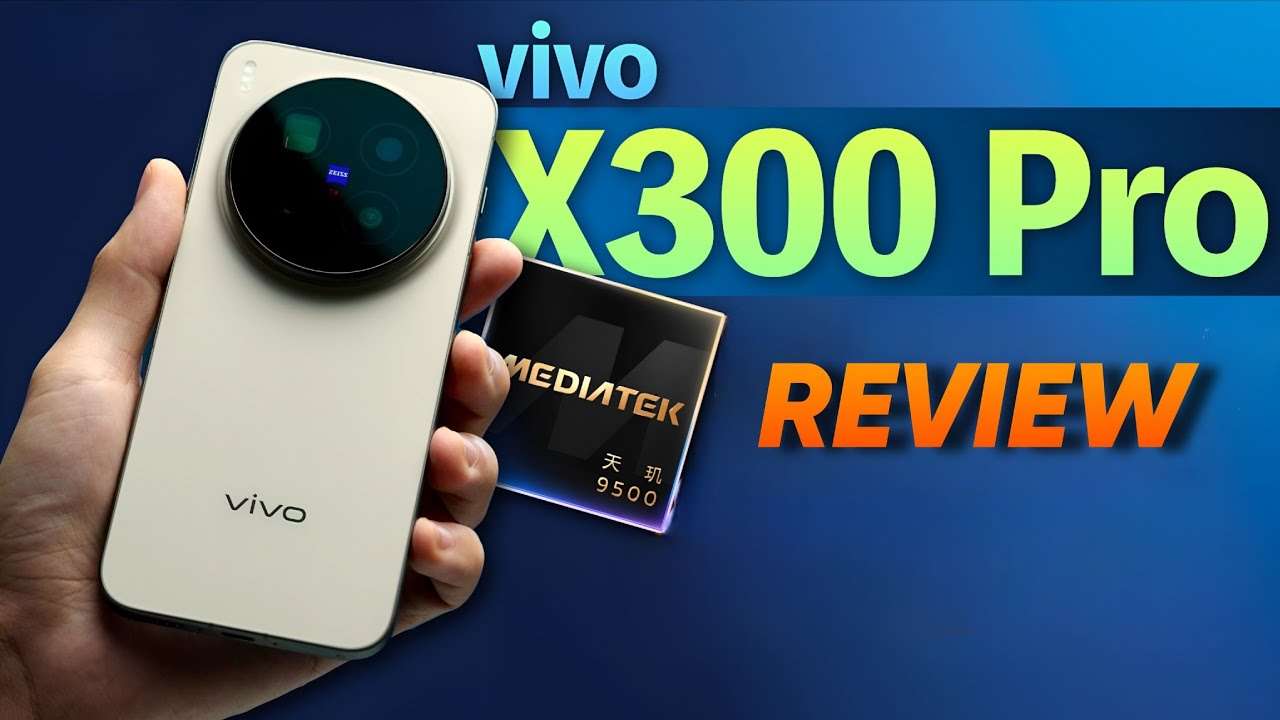
Some phones try to do everything and end up being remarkable at nothing. The Vivo X300 Pro does not have that problem. It was designed around a specific purpose professional-grade mobile photography and almost everything about it serves that goal. The 200MP ZEISS telephoto. The large Sony LYT-828 main sensor. The OriginOS camera interface built to handle both photographers and videographers. The extender kit that turns the phone into a literal 200mm telephoto system.
The rest of the phone is genuinely strong too. Battery life is excellent. The Dimensity 9500 handles everything thrown at it. The 6.78-inch display is sharp and bright. None of that is where the X300 Pro makes its argument. It makes its argument every time you zoom into a subject from thirty meters away and the shot comes back looking like it was taken on a dedicated camera.
This is a thorough look at everything: the launch date and pricing in India and globally, the full specifications, real-world performance, and an honest assessment of where it falls short.
1. Launch Date and Price — India, China, and Global
China launch: October 13, 2025
India launch: December 2, 2025
The Vivo X300 Pro launched in India faster than most Vivo flagships do just seven weeks after its China debut. That is a significant improvement over previous generations.
Pricing:
| Market | Configuration | Price |
|---|---|---|
| China | 12GB + 256GB | ¥5,299 (~Rs. 62,000) |
| China | 16GB + 512GB | ¥6,299 (~Rs. 74,000) |
| India | 16GB + 512GB | Rs. 1,09,999 |
| Europe | 16GB + 512GB | ~€999 |
| USA (grey market) | 16GB + 512GB | $994 – $1,050 |
India gets only a single variant: 16GB RAM + 512GB storage at Rs. 1,09,999. That is the only configuration officially available here. The phone is sold through Vivo’s official website, Flipkart, and offline Vivo stores across India.
The pricing is a significant jump over the Vivo X200 Pro, which launched in India at Rs. 89,999. That Rs. 20,000 increase will be a sticking point for some buyers. Whether it is justified depends on how seriously you take the camera upgrade which is substantial.
The optional ZEISS 2.35X Extender Kit for the telephoto lens is available separately and adds a true 200mm optical zoom capability to the phone.
2. Design — Refined, Premium, and Heavier Than It Looks
The Vivo X300 Pro carries the same design language as the compact X300, scaled up for a 6.78-inch chassis. The back features a frosted glass finish with a large circular camera island that is unmistakably Vivo. The frame is aluminum. The front glass is flat a deliberate choice that Vivo has stuck with across the X-series for multiple generations now.
Dimensions: 6.78 inches tall and compact relative to its display size. The circular camera module is prominent. It is the most recognizable design element on the phone and polarizing for the same reason you either find it bold or you find it obtrusive.
The phone ships with an IP68 rating for dust and water resistance, which is standard for a flagship in this price range but worth confirming. The ultrasonics fingerprint sensor is fast and reliable in testing.
Available colors: Black, Blue, White, and Brown.
The frosted glass back resists fingerprints well. The phone feels premium without feeling fragile Vivo has improved build quality noticeably compared to the X100 generation.
One legitimate criticism: the phone is heavier than some users expect for a 6.78-inch device. It does not feel light in hand.
3. Display — 144Hz QHD+ AMOLED That Earns Its Flagship Tag
The display on the X300 Pro is a 6.78-inch LTPO AMOLED panel running at up to 144Hz with a resolution of 1260 x 2800 pixels (QHD+). Contrast ratio is 8,000,000:1. HDR10+ is supported. Peak brightness in high brightness mode (HBM) hits 1,600 nits, and the panel also supports Dolby Vision for video playback.
The 144Hz panel is an upgrade over the X200 Pro’s 120Hz. It is not the first thing most users will notice but the smoothness of UI interactions especially scrolling is consistently excellent.
Touch sampling rate goes up to 300Hz in gaming mode, which makes the X300 Pro a capable gaming phone despite its camera-first positioning.
In everyday use, this is one of the best displays available on any Android flagship in 2025. Colors are accurate, outdoor visibility is strong, and the flat glass makes the screen feel more usable than curved alternatives for most daily tasks.
Key display specs:
- Size: 6.78 inches, flat
- Type: LTPO AMOLED, up to 144Hz
- Resolution: QHD+ (1260 x 2800px)
- Peak brightness: 1,600 nits HBM
- Contrast: 8,000,000:1
- HDR: HDR10+, Dolby Vision
4. Cameras — The Reason to Buy This Phone
This is the section that matters. The Vivo X300 Pro camera system is the best argument for its price and the reason 91mobiles has now called it “the camera phone to beat” for three consecutive years with the X100 Pro, X200 Pro, and X300 Pro.
Rear camera system:
- Main: 50MP Sony LYT-828 (1/1.28-inch sensor), f/1.57 aperture, Gimbal OIS
- Telephoto: 200MP Samsung ISOCELL HPB (1/1.4-inch sensor), 85mm equivalent, periscope design, OIS
- Ultrawide: 50MP
All three lenses carry ZEISS APO certification a distinction that indicates the optics are corrected for chromatic aberration, the distortion that makes edges in photos look color-fringing. APO is a standard used in professional photography lenses. Applying it to a smartphone telephoto is not standard.
The 200MP telephoto is the headline specification. At 85mm equivalent, it gives you real optical reach. Combine it with the optional ZEISS 2.35X Extender Kit and you get effective 200mm optical zoom the kind of reach that was previously available only in dedicated mirrorless cameras.
The main 50MP Sony LYT-828 sensor with Gimbal OIS produces consistently sharp shots in daylight. Night photography is excellent. Multiple reviewers, including Techaeris and Smartprix, named the X300 Pro camera system their favorite of 2025 above the iPhone 17 series and OnePlus 15.
Video recording:
- 8K at 30fps
- 4K at 120fps (both in Dolby Vision HDR and 10-bit Log)
- 1080p at 240fps (slow motion)
- ZEISS Cinematic video modes
Front camera: 50MP with autofocus
One point of nuance: low-light portrait shots show some inconsistency according to 91mobiles testing. This is not a disqualifying issue but it is worth noting that the camera is not uniformly perfect across every scenario.
5. Performance — Dimensity 9500 Does the Job
The X300 Pro runs on MediaTek Dimensity 9500 (3nm process) paired with Vivo’s in-house V3+ imaging chip, which handles computational photography tasks independently of the main SoC.
The Dimensity 9500 is a proven flagship chip. It does not match the Snapdragon 8 Elite Gen 5 in raw benchmark numbers 91mobiles notes that benchmark scores trail some Snapdragon-powered competitors but the real-world performance gap is small for everyday and gaming use. The conservative thermal tuning keeps the phone cooler during extended sessions.
In India, the sole variant ships with 16GB LPDDR5X RAM and 512GB UFS 4.1 storage.
Software: The X300 Pro launches with OriginOS 6 based on Android 16. This is the first major OriginOS overhaul in several years. The camera application has been rebuilt and the AI features are native rather than bolted on. Vivo has confirmed software support for multiple years of major Android updates.
Key performance specs:
- Chipset: MediaTek Dimensity 9500 (3nm)
- Imaging chip: Vivo V3+
- RAM: 16GB LPDDR5X
- Storage: 512GB UFS 4.1
- OS: OriginOS 6 (Android 16)
- Gaming: 300Hz touch sampling, dedicated gaming mode
6. Battery — One of the Strongest in Its Class
The X300 Pro carries a 6,510mAh silicon-carbon (Si/C) battery the silicon-carbon chemistry allows more capacity in the same physical size compared to standard lithium-ion cells.
In real-world testing, Techaeris reports a day and a half of solid heavy use and multiple days with light usage. Smartprix testing puts screen-on time between 6 to 8 hours depending on usage intensity. Both figures are strong for a 6.78-inch flagship with a 144Hz QHD+ display.
Charging is via 90W wired slightly slower than the Xiaomi 17 Pro’s 100W but still fast enough to go from flat to full in under 45 minutes. The 90W charger is included in the box.
Wireless charging is supported, though the wattage is lower than some competitors. Reverse wireless charging is also available.
One caveat: the European global model ships with a smaller battery than the Chinese version. If you are in India buying through official channels, you get the full 6,510mAh unit.
Key battery specs:
- Capacity: 6,510mAh (Si/C chemistry)
- Wired charging: 90W (charger included)
- Wireless charging: Supported
- Screen-on time: 6 to 8 hours (heavy use)
7. Connectivity and Other Features
- 5G: Yes, dual SIM
- Wi-Fi: Wi-Fi 7
- Bluetooth: 5.4
- NFC: Yes
- GPS: Multi-band
- USB: Type-C, USB 3.2
- IR Blaster: Yes
- Water resistance: IP68
Pros and Cons at a Glance
Pros:
- Best-in-class 200MP ZEISS telephoto with APO optics
- Excellent main camera with Gimbal OIS
- Outstanding battery life for a flagship with this display size
- OriginOS 6 is a significant software improvement
- 144Hz QHD+ flat display is among the best available
- Competitive India pricing compared to Samsung Galaxy S26 Ultra
Cons:
- No official warranty clarity for grey market imports
- Sole variant in India at Rs. 1,09,999 no entry-level configuration
- Some inconsistency in low-light portrait shots
- Heavier than expected
- 90W charging is slower than Xiaomi and iQOO competitors
Wrapping Up
The Vivo X300 Pro is the right phone for one specific buyer: someone who photographs and films seriously, wants professional-grade telephoto reach, and cannot or will not carry a separate camera. For that buyer, there is no better smartphone available in India at Rs. 1,09,999 or at any price below Rs. 1,40,000.
- Camera: Best telephoto system available on any phone in India at this price, full stop
- Battery: Among the top five in its class 6,510mAh with good real-world endurance
- Performance: Slightly behind Snapdragon benchmarks but competitive in everyday use
- Display: Excellent 144Hz, QHD+, flat, bright
- Buy it if: You priorities photography and want a capable all-rounder
- Skip it if: You want the fastest raw benchmarks (choose a Snapdragon phone) or the biggest battery (the OPPO Find X9 Pro has 7,500mAh)
At Rs. 1,09,999 against the Samsung Galaxy S26 Ultra at roughly Rs. 1,30,000 and the Xiaomi 17 Ultra at Rs. 1,39,999, the X300 Pro offers more camera for less money than either. The ZEISS Extender Kit is an optional extra that serious photographers will find genuinely useful. Everyone else can leave it.
Read Also:
Azure Synapse Analytics Tutorial for Data Analysts Complete 2026 Guide
50 SQL Interview Questions for Data Analysts With Answers
Xiaomi 17 Pro Review: Price, Specifications, and Everything You Need to Know
Job Notification Join us on Telegram: Click here
Job Notification Join us on WhatsApp: Click here